007 First Light by IO Interactive
Background
I should start by saying I’m a long-time 007 fan. Let’s recount my history with 007, because it wasn’t something I was born into. It was something I discovered — not as a child, but as a budding adult in high school. At least, that’s my theory from what I can remember.
I do know it was the games that really introduced me to the franchise. Particularly, 007 Nightfire for the Gamecube. That was my splitscreen shooting foundation. I think it was a combination of the bonding experiences — no pun intended — I made with friends through playing the game and the sophisticated charm of the franchise that got me hooked. I’ve always had a thing for nuance and moral complexity, and Bond does that well.
But it wasn’t just the games. It was also the music. I love the grandiosity of Bond music. Often orchestral, and generally vocally impressive, excusing Another Way to Die by Alicia Keys and Jack White which ranks among the worst songs of all time, 007 aside.
But really, I think it was the sophistication and impactfulness of the franchise. I’ve never fully understood the plot and themes of a Bond film the first time watching it. That’s a result of sophisticated, nuanced story-telling. I can’t stand heavy-handed storytelling; it’s worse than unstimulating, it’s like brainwashing, being fed the propaganda the writer wants you to take away from the story. And for impactfulness, the plots of 007 generally involve advanced technology (for the time) that is used to manipulate on a global scale for money and power. It’s almost an insight into realpolitik — which, to sum up in a sentence the modern sense of the word, just means “how powerful organizations actually function globally behind the scenes”.
I’ve since watched every Bond film and read many of the Ian Fleming novels. But let’s return to the game at hand. 007 First Light — the first AAA game I’ve played since Skyrim.
THEIA — Near-Future AI Intelligence System
Artificial Intelligence Intelligence System. You heard that right. Two forms of “intel-” at hand here: intellect and intel.
The plot of First Light revolves around an advanced AI computer developed by Webb Industries, a (fictional) tech company that has its origins in developing defense weaponry and aircraft in the early 20th century. I think it’s likely the game’s plot or at least script shifted slightly to match the technology’s advancements. Or, IOI was just very tied in with progress that was being made in the AI sector, which is also believable.
Reasonably, Webb Industries made a shift to the computing sector. Presenting — THEIA, a 2nd-gen quantum computer that accesses vast global data feeds and leverages AI to perform predictive analysis as intelligence output to MI6. For the visual folks, here’s a diagram:
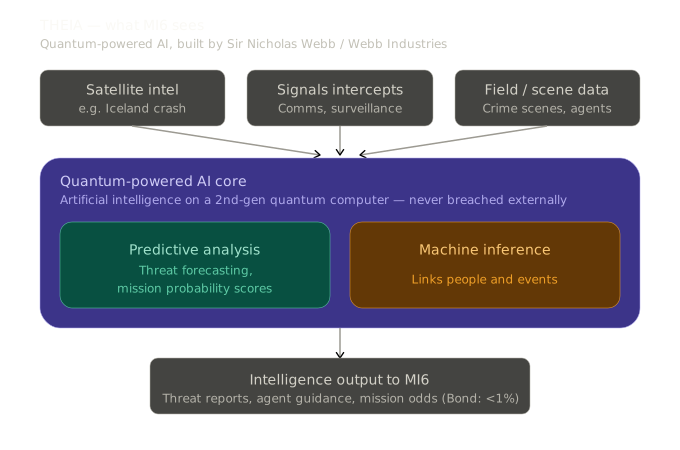
To the best of my knowledge, systems like this currently exist in some capacity, pardoning the “quantum core” elements that are a bit less relevant. But let’s dissect the tech stack presented and assess plausibility.
Tech Stack Analysis
The game understandably doesn’t go in-depth into the THEIA system architecture, but there are some key statements that we can use for inference, and I’ll paraphrase below. Note that I’m going off of memory — I should really do a text dump from the game’s source code, but I’ll respectfully decline taking on that task for now:
- Mass global intel collection, utilizing radio signal intercepts, remote sensing to survey earth surface, and global event field reports
- Predictive analysis utilizing AI/ML
- Quantum computing core
- Serves summarized intel briefings and mission success odds
So let’s discuss whether any of that makes sense.
The mass global intel collection certainly does. We’ve had satellites collecting global intel since the 1960s, and radio signal intercepts date back to birth of radio itself, and became prominent in WWI.
The predictive analysis using AI/ML is also plausible, but I think it’s important to recognize that it likely has been for quite some time. If we treat AI as the umbrella term, and LLMs as a specific type of ML, then the mainstream LLM families like Claude and GPT are less relevant to the type of AI/ML present in 007 First Light. LLMs set the world on fire because they’re pretty good at… everything. You can ask it about anything, even problems that have never been asked or answered before, and it can come up with solutions without having been explicitly taught anything. But LLMs are pretty bad at applying measurable confidence — that’d be more in line with traditional task-specific models, like image recognition. Some players online, particularly those with critical views on AI in general, celebrated the plot themes as anti-AI sentiment. The beauty of a 007 story is there’s nuance, so there’s not only a single interpretation; I personally didn’t find the themes anti-AI at all. But I’ll avoid spoilers!
Quantum computing core — now I’ll admit, my understanding of quantum computing is less than suitable to accurately determine whether quantum computing could even be relevant at all in a super-intelligent system like THEIA. From my understanding, quantum mechanics have more application to things that are… quantum in nature. Think mathematics, physics, and chemistry. It’s less relevant in a problem where you need to analyze vast amounts of messy, real-world data and try to make sense of it. If we’re giving THEIA the benefit of the doubt, we can pretend the quantum aspects were strictly responsible for the security of the machine, as it’s stated to be impenetrable from the outside. Quantum chips certainly play a role in cryptography.
And then finally, the intel briefing reports THEIA produces for MI6. This is probably the most unrealistic aspect of the technology stack — specifically, that THEIA is infallible and that THEIA can produce reliable mission outcome odds. MI6 pretty blindly put trust in THEIA, trusting that it never makes mistakes. Hopefully, no organization follows in those mindsteps. And I guess to give an explanation for how it’s able to produce mission odds — using the vast amount of data available, it likely runs simulations to determine every possible outcome (playing into the popular misconception of what quantum really means). But we’re nowhere near the technology to set up accurate simulations on the fly like that. Machines aren’t yet omniscient.
Realizations — Ambient Computing and Tech Ecosystems
007 First Light was set in present day — 2026, precisely. Playing through the game, somehow I hallucinated and felt like there was more advanced tech in the game than there really was. Other than Q Lab gadgets, THEIA, and… well, I won’t give spoilers, the world was pretty on-par with the current state of the tech world.
But it did get me thinking about this — what’s next for big tech? Tech continuously evolves, if we were to look at its advancement on a graph, but there are definitely points where we get over a major hurdle, and everything changes. The internet is a prominent example. But so are LLMs.
I started getting this feeling that we’re living in a world that is architected for the past. Or, being less dramatic, the infrastructure hasn’t caught up to the software, yet. It’s true that in previous years, computing devices have been deployed closer and closer to the edge — we went from server rooms, to computers at homes, to computers in our pockets, to computers on our fingers, eyes, wrists, and in our walls. In our instruments, cars, and home appliances. I don’t see any reason why that trend won’t continue. I didn’t know there was a word for it, though — ambient computing.
Ambient computing is the concept that tech will integrate seamlessly into our lives and culture. It’s not “invisible tech” in my opinion. A good example is the tram at airports — automatic public transport that’s managed by a system. You could have a system that manages hundreds of automatic public transport vehicles. That’s not invisible but it does seamlessly blend in with our daily lives.
I think the emergence of LLMs will be paramount to a boom in ambient computing. Without LLMs, you can deploy tech anywhere, and it can do what it’s programmed to do, but it’s not aware of context in the way humans are. The tech around you can understand what’s going on around it. It’s all kind of abstract sounding, but I think there’s an avenue that leads to a significantly more dynamic and connected world.
But let’s try to be less abstract, let’s give a real example: androids. We’re not far off from androids at all. A certain trillionaire is actively pursuing that technology, and would like to see every family that wants one be able to have one. LLMs have that “good at pretty much everything” quality that’s required of humanoid robots.
But also, just consider massively connected tech ecosystems. Your transportation, phone, public surveillance, news, personal records, and — maybe with technologies like neuralink — even your state of mind could all be connected. Everything lives and breathes and responds together. But I sense that current tech ecosystems aren’t set up for this type of opportunity.
Competition in the AI Era
I do think competition is inherently an excellent driving force for success. It historically has been. But I think it’s important we think about why that might be. Without getting too philosophical, it’s reasonable to simply state that competition motivates. It forces your hand, so you have to play. If you don’t, you lose. And sometimes, to lose is to die.
But what happens when the primary producers for society no longer require motivation? Once humans are out of the loop, human competition becomes… I’m honestly not sure. Unnecessary? Futile? Inapplicable? Autonomous systems can compete with themselves.
What I’m getting at is eventually, if we fast-forward hundreds of years, I’m starting to think competition may do more harm than good. In the previous section I was talking about how tech could harmoniously connect everything, but that doesn’t work when there are a bunch of different competing ecosystems. This is not a critique on tech companies like Amazon and Meta that are actively working to build these ecosystems. And it’s certainly not a critique on free-market economy. They’re genuine questions. How would we manage a society where we no longer need competition to drive innovation? Maybe there’s a flaw in the whole premise, but I think it’s something that warrants attention of the highest orders. Maybe sooner rather than later, but also not being too hasty or fatalistic with policy and judgement.
Closing Thoughts
Kind of went off the 007 topic for a minute there. But I feel like that’s where I’m going to close, too. The game inspired me to think about some of these things, and I wouldn’t have written this article if it hadn’t.
Do we have a solution for a society where entire fields increasingly become obsolete? Do people just adapt? I’m actually not too worried about myself, as a software engineer; my point of view is that I’m living in the most opportunity-rich field in the history of mankind, rather than living in volatile times. The way I see it, until we live in a society that’s post-scarcity, post-labor, environmentally sustainable, etc., there will always be opportunities for a guy like me. But that’s just because I’m able and willing to invest hundreds, or thousands of hours to adapt. Many people either aren’t, or can’t. It’s a serious problem that I don’t think we’re ready to solve yet. But I do think dialogue — not policy, yet — needs to start very soon.
🍸 If you’re a 007 fan, or a gamer that appreciates good stories, I highly recommend 007 First Light. 10/10 will replay again.